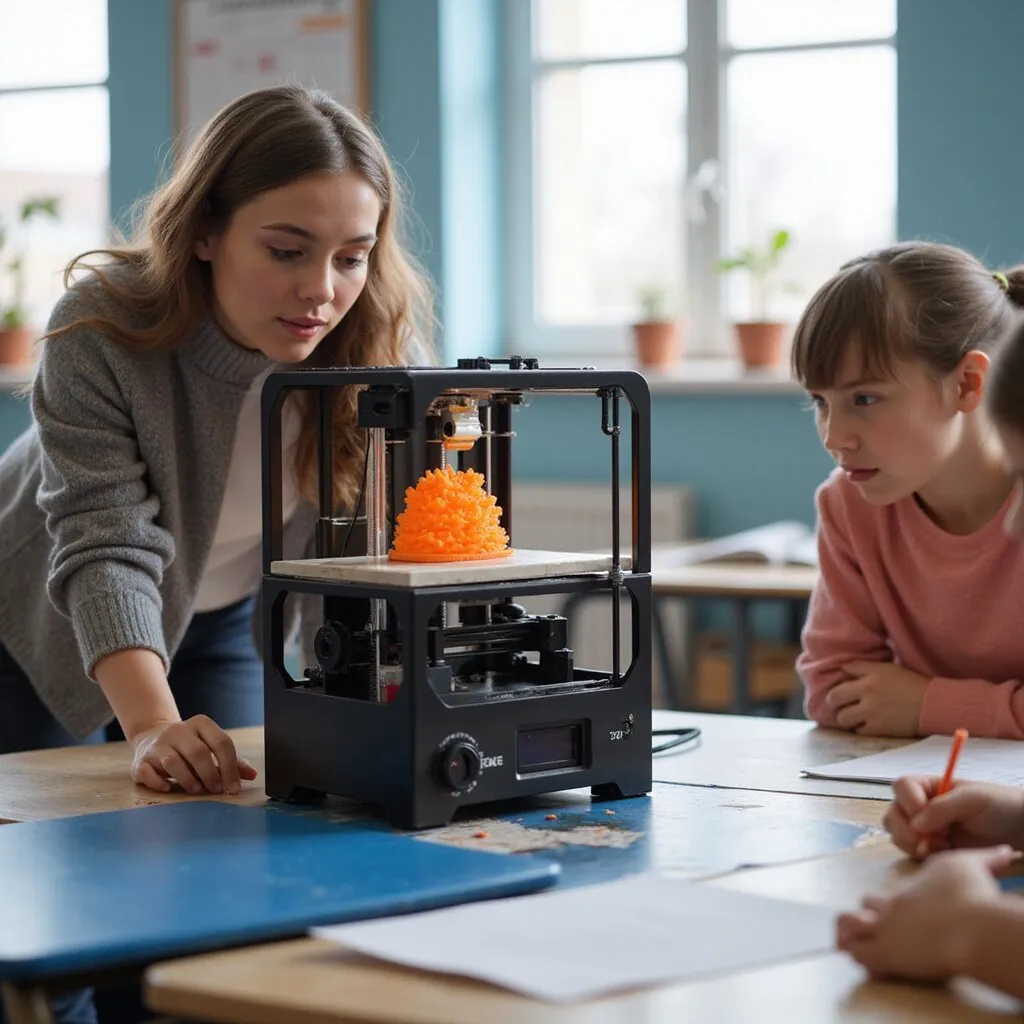
FDM printers match real classroom conditions. They are durable for frequent use, simple for teachers to manage, and flexible across subjects. Teachers can switch between student projects without complicated setup or constant recalibration.
Administrators value predictable operating costs. Filament is affordable and maintenance is straightforward. IT teams benefit from network connectivity, user controls, and remote monitoring. With support from AGC Education, districts deploy FDM printers with training and classroom workflows to ensure consistent results.
Resin based printers, also called SLA or MSLA, offer high detail but require liquid resins, safety handling, and post processing. These requirements increase complexity and classroom risk. Powder based and industrial printers are expensive and require specialized facilities, making them impractical for most schools.
Because of these limits, most schools standardize on FDM printers for classrooms and makerspaces. This simplifies training, maintenance, and district wide curriculum development.
Most Common 3D Printer Type for Schools: How to Choose the Right Classroom 3D Printing Solution
The most common 3D printer type for schools is FDM, also known as fused deposition modeling or fused filament fabrication. These filament printers are affordable, durable, and use thermoplastic materials like PLA, PETG, and ABS, making them ideal for classrooms and makerspaces. FDM printers extrude melted plastic through a nozzle onto a print bed and are easy for beginners to learn and maintain.
If your program requires higher precision, smoother surface finishes, or tighter tolerances, resin based printers such as SLA, DLP, or MSLA may be suitable. However, these systems require more maintenance, post processing, and safety considerations, which can limit classroom scalability.
Why the Most Common 3D Printer Type for Schools Matters for Learning Outcomes
The most common 3D printer type for schools is FDM printing technology. This method directly supports learning outcomes by increasing student access to printers, reducing failed prints, and lowering the cost per project. Reliable printing helps teachers keep lessons on schedule and ensures more students can participate in hands on learning activities.
FDM printers use affordable thermoplastics like PLA, PETG, and ABS, allowing students to iterate designs without increasing classroom costs. This supports project based learning, design thinking, and real world engineering practices.
How 3D Printer Types Impact STEM, CTE, and Cross Curricular Instruction
Printer selection affects how easily students can prototype, test, and revise designs. STEM programs use FDM printers for engineering challenges, robotics parts, and scientific models. CTE programs rely on them for manufacturing fundamentals, tolerances, and mechanical design. Art and design classes use them to explore form, geometry, and functional aesthetics.
Linking 3D Printing Technology to Standards, Project Based Learning, and Career Pathways
When aligned with learning standards, 3D printing strengthens critical thinking, collaboration, and applied problem solving. Students gain exposure to modern manufacturing methods, preparing them for careers in engineering, product design, healthcare modeling, and advanced manufacturing. These experiences bridge classroom theory with real world technical skills.
What Is the Most Common 3D Printer Type for Schools Today?
Across educational institutions, the most common 3D printer type for schools is FDM printing. These printers melt thermoplastic filament and build objects layer by layer. They are widely used because they fit classroom budgets, require minimal maintenance, and are easy to operate with basic training.
FDM printers are commonly used in STEM, CTE, and art programs. They allow rapid prototyping, functional testing, and repeated iteration without the safety concerns associated with liquid resin handling.
Why FDM 3D Printers Are the Most Common Choice in K 12 Classrooms
FDM printers are popular because they balance affordability, durability, and ease of use. Teachers can quickly train students to operate them, while administrators appreciate the low operating costs and predictable maintenance. These printers also scale well across multiple classrooms or schools.
Key Advantages of FDM 3D Printers for Schools: Safety, Simplicity, and Affordability
FDM printers use solid filament materials that are easy to store and handle. Many models include enclosed build chambers, automatic bed leveling, and classroom friendly controls. These features improve safety, reduce setup time, and support consistent print quality.
Common FDM Classroom 3D Printer Features Procurement Teams Should Look For
Procurement teams should prioritize enclosed designs, automatic leveling, filament detection, reliable firmware, and strong customer support. Build volume, print speed, and compatibility with common filament types should also be evaluated to match classroom needs and budgets.
How the Most Common 3D Printer Type for Schools Compares to Emerging Technologies
FDM printers provide durability and accessibility, while resin printers offer higher resolution and smoother finishes. Industrial systems provide advanced performance but exceed most school budgets. Schools benefit from starting with FDM and selectively adding advanced technologies when specialized outcomes are required.
Balancing Innovation With Reliability When Standardizing on a 3D Printer Type
Standardizing on a reliable FDM platform reduces training complexity and maintenance overhead. Introducing new technologies should be purposeful, supporting advanced coursework or specialized projects without disrupting daily classroom operations.
Overview of 3D Printer Types Used in Schools and Makerspaces
Schools commonly choose between FDM printers, resin printers such as SLA and DLP, and industrial grade systems. Each type offers different materials, maintenance requirements, and learning outcomes. FDM printers are best for everyday classroom use, while resin printers support high detail projects.
FDM vs Resin vs Industrial 3D Printers: What School Leaders Need to Know
FDM printers offer low operating costs and simple workflows. Resin printers provide higher resolution but require post processing and chemical handling. Industrial printers offer performance and durability but require facility upgrades, service contracts, and higher budgets.
Safety, Ventilation, and Supervision Considerations by 3D Printer Type
FDM printers benefit from basic ventilation and enclosed designs. Resin printers require careful handling, proper ventilation, and safety protocols. Industrial printers may require dedicated rooms and professional supervision due to heat, emissions, and power requirements.
Which 3D Printer Types Align Best With Elementary, Middle, and High School Use Cases
Elementary classrooms benefit from simple, enclosed FDM printers. Middle schools can expand into functional prototyping and engineering projects. High schools and CTE programs may introduce resin or industrial printers for advanced design and manufacturing workflows.
How to Evaluate the Best 3D Printer Type for Your School or District
Choosing the most common 3D printer type for schools starts with defining learning goals. For most classrooms, FDM printers provide the best balance of affordability, durability, and ease of use. Resin printers support high precision projects but require more training and oversight.
Key Criteria for Choosing a School Friendly 3D Printer Type
Evaluate build volume, print speed, reliability, ease of maintenance, and material compatibility. Consider training requirements, curriculum alignment, and support availability. These factors determine long term success and adoption across classrooms.
Total Cost of Ownership: Consumables, Maintenance, and Lifecycle Planning
Total cost includes filament or resin, replacement parts, service plans, and staff time. FDM printers generally offer the lowest long term costs, while resin and industrial systems require higher recurring expenses.
IT, Network, and Data Privacy Considerations for Connected 3D Printers
Network connected printers should follow district IT policies. Ensure firmware updates, secure network access, and student data protection are in place before deploying connected devices across schools.
Classroom Implementation: Making the Most Common 3D Printer Type Work at Scale
Scaling 3D printing across schools requires standardization. Use consistent FDM models, approved filament types, and shared slicer profiles. This reduces troubleshooting and improves reliability across classrooms.
Best Practices for Deploying FDM 3D Printers Across Multiple Schools
Standardize hardware models, filament brands, and slicer settings. Train staff on maintenance basics and create shared troubleshooting guides. This consistency improves uptime and reduces technical issues.
Managing Print Queues, Student Access, and Classroom Workflows
Implement print scheduling systems and clear usage rules. Assign student roles for printer setup and monitoring to reduce teacher workload and keep projects moving efficiently.
Training Teachers and Students on Safe, Effective 3D Printer Use
Provide structured onboarding sessions, safety guidelines, and quick reference materials. Ongoing professional development ensures long term success and confidence in using 3D printing across subjects.
How AGC Education Supports Schools in Choosing the Right 3D Printer Type
AGC Education helps schools select the most common 3D printer type for schools using a structured evaluation process. Most programs begin with FDM printers due to affordability, durability, and ease of classroom integration.
Schools receive guidance on comparing FDM, SLA, and SLS technologies based on build volume, materials, maintenance, and instructional goals. This ensures purchasing decisions support long term classroom success.
From Device Selection to EmpowR Academy Training: A Full 3D Printing Ecosystem
AGC supports schools with device selection, curriculum alignment, and educator training. This ecosystem approach ensures printers are not only purchased, but fully integrated into instruction.
Implementation Support, Student Certifications, and Ongoing Success Coaching
Ongoing support includes implementation planning, classroom workflows, and student certification pathways. Continuous coaching ensures 3D printing programs remain effective, scalable, and aligned with evolving curriculum goals.
Next Steps: Selecting the Most Common 3D Printer Type for Schools That Fits Your Vision
Choosing the most common 3D printer type for schools begins with aligning technology to educational goals. FDM printers support daily learning and iterative design. Resin printers support advanced precision work. Selecting the right mix ensures long term success and student engagement.
Action Checklist for Evaluating and Adopting a Classroom 3D Printer Type
Define learning objectives, evaluate total cost of ownership, pilot test sample prints, train staff, and standardize equipment. A clear rollout plan ensures your 3D printing program scales smoothly and delivers consistent educational value.
sla 3d printers sls 3d printers 3d printer sla 3d printer 3d printers fused filament fabrication 3d printers fused deposition modeling 3d printers fff 3d printer fused deposition modeling 3d printer sla fff fused deposition modeling 3d printer fff sla fff 3d printer fff sla 3d printers fused filament fabrication sla 3d printer sls 3d printers stereolithography 3d printers 3d printer 3d printers 3d printers fff stereolithography dlp 3d printer 3d printers sla